
How do you support dysregulated family law clients?
Male clients in high-conflict matters can feel more challenging to work with than they should be. Professional Development can change that.
Stand Again provides in person or virtual workshops for your legal teams, that are applicable for Substantive Law or Professional Skills CPD Units.
Foundational Interactive Workshop
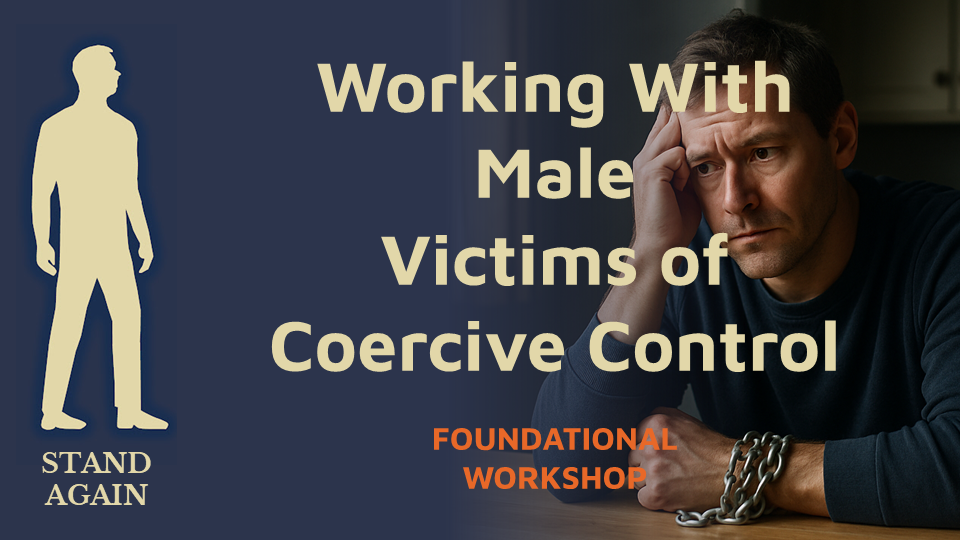
Working with Male Victims of Coercive Control
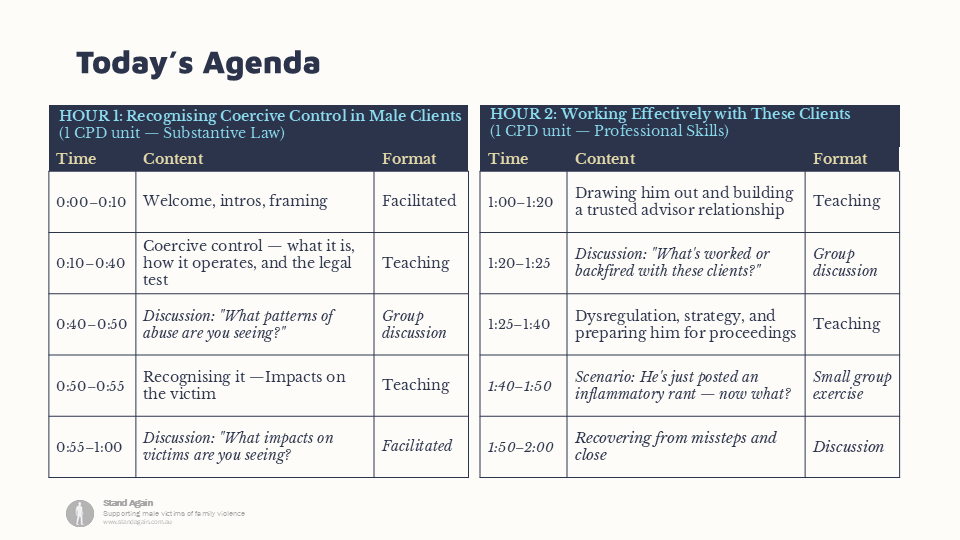
2 hours (1 or 2 sessions) | 2 CPD units (Substantive Law & Professional Skills)
Up to 15 attendees
This workshop equips your team to recognise what you're seeing in male clients, draw out what you need for their case, and keep them aligned with legal strategy when their nervous system is working against them.
What we cover:
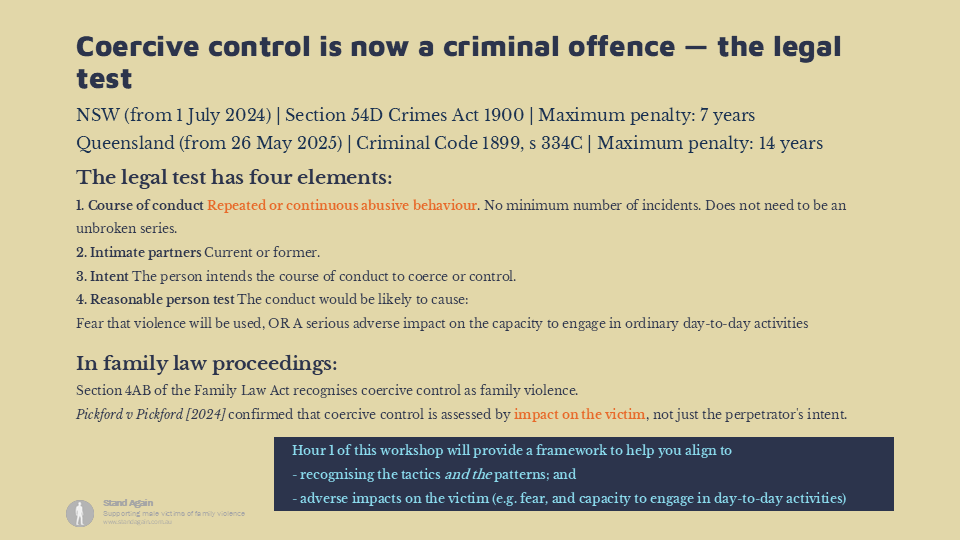
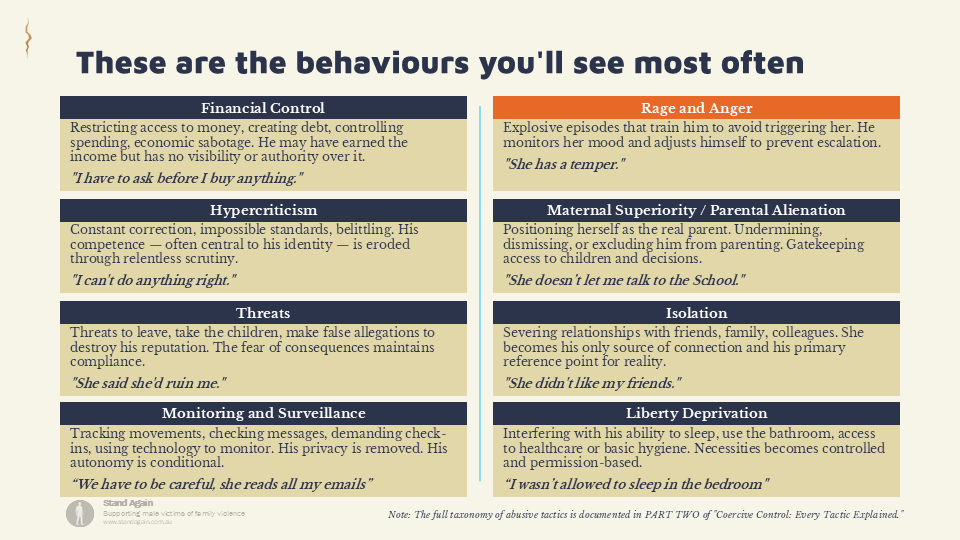
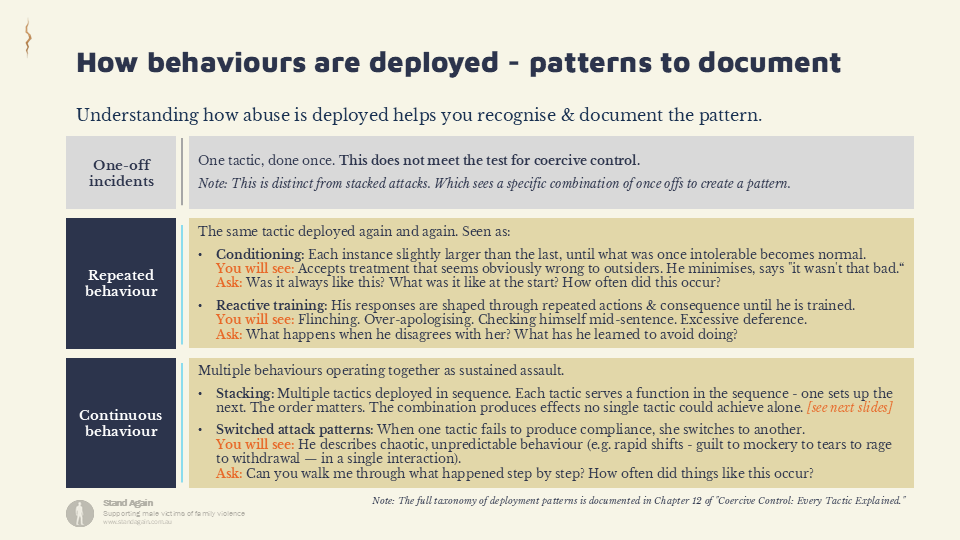
- Recognising coercive control in male clients - a framework for recognising the patterns of abuse and impact to the client
- Drawing out information from men who are shut down - questions that open him up vs questions that close him off
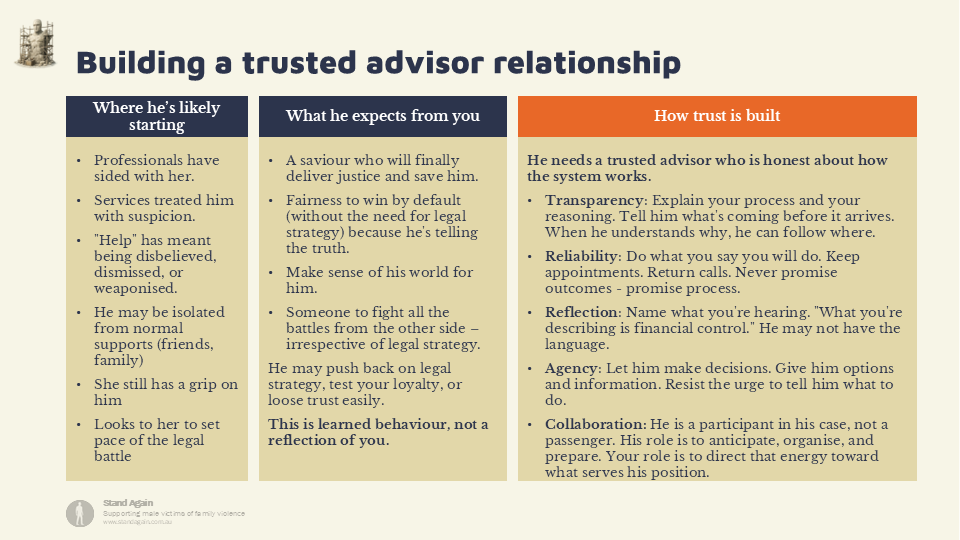
- Engaging without pushing him away - what keeps him open vs what makes him withdraw
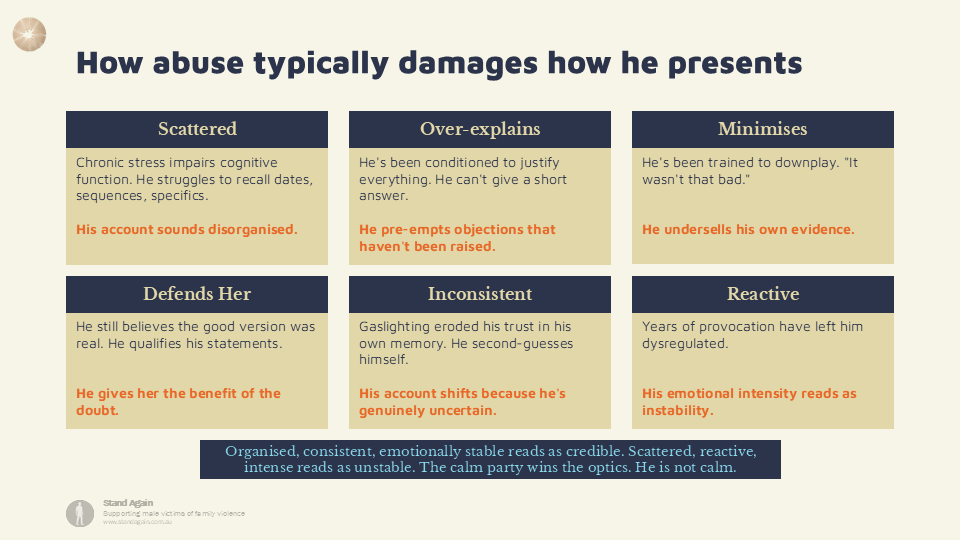
- Likely areas of dysregulation that may damage cases – and how to address the underlying driver
- Keeping him steady through proceedings - what to say and what not to say when he's dysregulated
- Recovering after a misstep – how to debrief and regroup with him so he’s realigned to the strategy
Learning outcomes:
Participants completing this workshop will be able to:
- Recognise coercive control presentation in male clients
- Draw out information from clients without triggering withdrawal
- Deliver advice and frame strategy in ways that maintain trust
- Explain provocation and reactive abuse in terms clients can act on
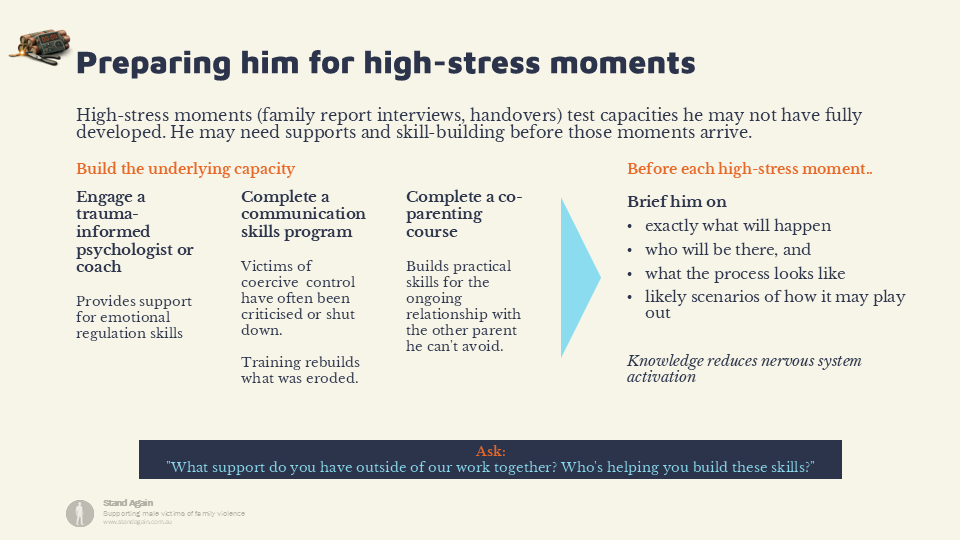
- Pre-brief clients for high-stress moments
- Recover the relationship and realign strategy after missteps
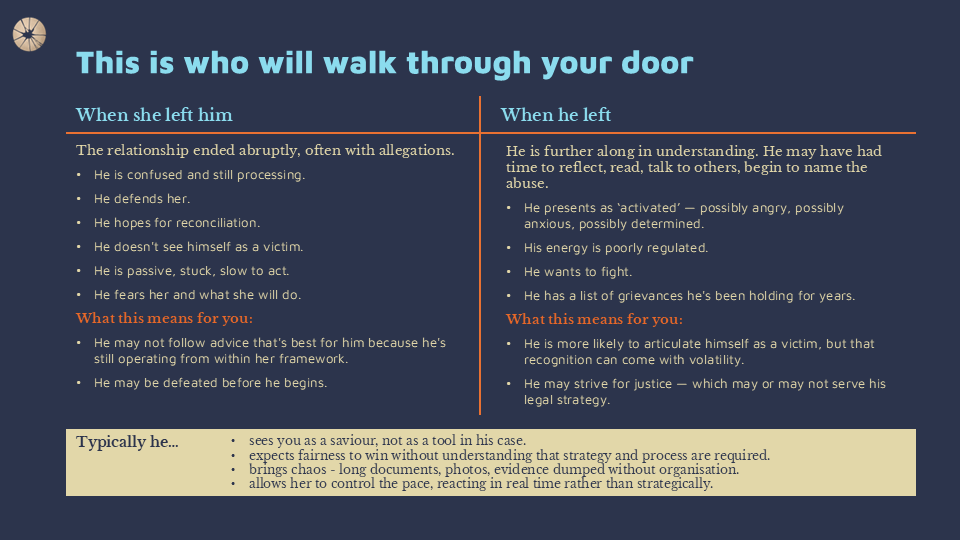
Sample slides from the Foundational Workshop


Deep Dive Interactive Workshops
These shorter interactive sessions build on the foundational workshop, going deeper on specific challenges your team encounters.
WHY HE DOESN'T TRUST YOU YET
60 minutes
1 CPD unit (Professional Skills)
Up to 8 attendees
He's not following advice. He's protecting her. He's minimising what happened.
This isn't obstruction — it's conditioned behaviour. This session unpacks what's driving his resistance and how to work with it.
Covers:
- Trauma bonding.
- Why he defends her.
- How advice-giving can mirror her control.
- Building trust with someone whose trust has been weaponised.
THE
COERCIVE CONTROL LANDSCAPE
90 minutes
1.5 CPD units (Substantive Law)
Up to 8 attendees
A deeper look at tactics, domains, and patterns.
Builds your team's ability to identify, name, and articulate what your client experienced in ways that translate to court.
Covers:
- The nine domains of control.
- How tactics compound.
- Pattern recognition versus incident focus.
- Building coherent narratives.
- Language that aims to resonate with judges and evaluators.
WHEN SHE LEFT VS
WHEN HE'S LEAVING
60 minutes
1 CPD unit (Professional Skills)
Up to 10 attendees
Two clients, two presentations. When she initiated, he's confused, defending her, hoping for reconciliation.
When he's leaving, he's further along, possibly activated and ready to fight.
Covers:
- How recognition differs.
- What each means for engagement.
- The client who doesn't see himself as a victim versus the one ready to fight.
DEFENDING THE CLIENT WHO FOUGHT BACK
60 minutes
1 CPD unit (Substantive Law)
Up to 8 attendees
He shouted. He shoved. He sent messages he regrets.
Now it's evidence against him. Courts see the reaction, not the coercion that preceded it.
Covers:
- What reactive abuse is.
- Provocation as tactic.
- Presenting context to courts.
- Helping him understand his own reactions.