
The Nine Players Every Man Needs On Their Side Through Recovery
The Value of a Support Network
Coercive control is, at its core, an isolation project.
It works by thinning the connections around you until the only voice you hear consistently is the voice of the person causing the harm. Friendships fade. Family contact becomes a source of conflict. Social events get sabotaged. And the result is that by the time you recognise what has been happening, you are standing in a space that feels very empty.
Rebuilding connection is part of undoing that damage. Having people around you who understand what you are going through, or who are willing to learn, changes the experience of living through it. It breaks the closed loop. It gives you access to perspectives that have not been distorted by the dynamics inside your home. It creates a foundation that holds when the ground beneath you is shifting.
I have written separately about the act of telling the people in your life what is happening to you, in How to Tell Your Family and Friends You’re a Victim of Domestic Violence as a Man. That article is about breaking the silence. This article is about what comes next. Once you have spoken, once people know, the question becomes: what kind of support do you actually need, from whom, and when?
A support network is not just friends and family. It is anyone or anything that performs a genuine function in your recovery.
A therapist. A coach. A colleague. A book you read at two in the morning when you cannot sleep. A YouTube channel that gives you language for what you have been experiencing. A mate who knows the full story and deliberately creates space where it is not the point. The network is broader than most men realise, and it is built around functions, not relationships.
Not All Support Is Right for the Moment
One of the things that catches men off guard during recovery is discovering that support which feels helpful can cause harm when it arrives at the wrong time. A friend who wants to take you out and help you blow off steam is exactly what you need when you are rebuilding your life in the later stages. That same friend, offering the same thing while you are in the middle of a custody battle, can lead to decisions you cannot undo.
The support you need changes depending on where you are in your journey. At Stand Again, we frame that journey in four stages: Educate, Survive, Recover, and Thrive. Each stage has a different aim, a different set of challenges, and a different set of needs. The person who is essential to you in one stage may need to step back in another. The energy that feels premature in Educate may become exactly what you need in Recover.
Understanding this is what separates a support network that works from one that adds confusion. The people around you are not the problem. The timing and the function of their support is what matters.
This Is a Guide, Not a Strict Regime
Your support network does not need to be perfect. It does not need to be complete on day one. It does not need to look like anyone else’s. What it needs is to exist, and to be built with enough intention that the right functions are being covered at the right time.
Some of the players described in this article will be filled by a single person who covers multiple roles.
Some will be filled by a professional. Some will be filled by a resource you access alone in your own time. Some positions will remain empty for a while, and that is okay. This is a framework to help you think clearly about what you need, notice the gaps, and make deliberate choices about how to fill them.
Recovery is not linear. You may move between stages. You may sit in one stage for a long time and then shift quickly through another. Your support network should reflect where you actually are, and it should have permission to evolve as you do.
If Connecting Feels Like the Hard Part
For many men reading this, the challenge is not understanding the framework. It is the act of reaching out in the first place. Coercive control damages your ability to connect. It installs a deep distrust of other people. It trains you to believe that vulnerability will be punished, that asking for help is evidence of failure, and that the safest option is to handle everything alone.
After years of that conditioning, the social muscle has atrophied.
You may genuinely not know how to start a conversation that goes deeper than the surface.
This is expected. It is a direct consequence of what was done to you, and it is something that rebuilds through practice. You do not need to fill all nine positions in a week. You can start with one. You can start with a resource that requires no human interaction at all: a book, a channel, a structured programme. That is a legitimate first step. It fills the Kit Bag position and it gives you language and frameworks that make the next step, reaching out to an actual person, easier.
When you are ready to bring someone in, start with the person who feels safest. One conversation. One role. You can build depth into an existing friendship gradually by sharing a small piece of what you are going through and seeing how it lands. The first conversation will feel unnatural. The tenth will feel easier. Connection is a skill. It was damaged. It can be rebuilt.
How to Construct a Support Network
A support network is built around functions. I call these functions “players” because the metaphor holds: you are building a team. Each player has a specific role on the field. At different stages of the game, different players need to be playing. Some start on the bench and get called up later. Some are on from the first whistle. You pick who plays each position.
A single person can play multiple positions.
Your brother might be your Anchor and your Mirror. Your therapist might be your Analyst and your Tank. A book can be your Kit Bag. A coach you have never met in person can fill the Captain position through a screen. The point is not who the person is. The point is whether the function is being covered.
A small squad, with the right players covering the right positions will carry you further than a large circle with no structure.
Five people filling genuine functions is stronger than twenty people offering vague, undirected goodwill.
When you look at your life and ask “who do I have?” the question that matters is not how many. It is whether the positions are covered.
Three more thing also worth being direct about.
- During Educate and Survive, certain positions benefit significantly from someone with professional training. The Analyst and the Physio in particular are doing work that touches trauma, perception, and emotional regulation. A good friend can fill these roles partially. A therapist or trauma-informed coach can fill them fully. If you are in the acute stages and you have access to professional support, that is where these positions should sit.
- Your children are never a part of this team. It can be tempting, particularly when you are isolated, to lean on older children as confidants or to use them as emotional anchors. They cannot carry that weight and it is not their role. What to share with your children about your experience is a complex topic that I will address in a future article. For now, the principle is clear: build your team from adults.
- I have written in the disclosure article about flying monkeys, people who may be functioning as extensions of your partner's narrative without realising it. Before you open up and assign someone a role in your recovery, consider whether they are genuinely on your side. If there is any possibility that what you share will travel back to your ex, that person is not a player on your team. They are a risk. Choose your team with care.
Communicate what you need
Most people in your life want to help. Very few of them know how. If you have not told someone what you need from them, they will default to what feels natural to them, and that may not be what you need at all. Give yourself permission to tell others what you need from them in the moment. If they move in a direction that does not serve you, set a clear boundary: “Right now I just need you to listen. I’m not ready to do the other thing yet.” That is not rejection. It is direction. And most people, when given clear direction, are relieved to have it.
You can make it easier for the people around you to play their position well by giving them something to work with. If someone in your life wants to understand what you are going through and how to help, Reaching Him was written specifically for the families and friends of men in abusive relationships. Handing it to your brother, your friend, or your mum removes the burden of having to educate your own support network while you are also trying to recover. You should not have to teach people how to support you at the same time as needing the support. A good resource does that work for you.
People will also let you down during this process. That is part of it. They are human. They will say the wrong thing, react in a way that hurts, or fail to show up when it matters. Some of that is their limitation. Some of it is the result of unclear expectations. If you have not communicated the role you need someone to play, they will fill the gap with whatever they think is right, and that gap between what you needed and what they gave is where disappointment lives. Communicate early. Communicate clearly. And when someone genuinely tries and gets it wrong, give them the grace to try again.
The Nine Players
Each player fills a specific function in your recovery. What follows is a brief introduction to each one. The real depth of how these players operate comes in the next section, where each one is mapped to the stage where they are most needed.
- The Analyst. Helps you untangle the mess and think clearly when your perception has been distorted. Validates that what you are seeing is real. Could be a therapist, a coach, an analytical friend, or a structured programme.
- The Physio. Helps you manage emotional intensity, either as an outlet when the pressure needs releasing or a settling presence when you need to come down. Could be a therapist, a close friend, a gym partner, or a grounding practice like exercise or journaling.
- The Tank. A safe space for expression with no judgement. What you say stays in the room. Could be a therapist, a close friend with proven discretion, a sibling, or a confidential support group.
- The Captain. Pushes you to get back up. Direct, tough, believes in your capacity. Could be a mentor, a professional coach, a friend who has navigated hardship, or a content creator whose voice challenges you.
- The Mirror. Someone you can be fully vulnerable with. The deepest level of trust. Could be your closest friend, a sibling, a therapist, or a peer who has been through it. You will likely only have one or two. That is enough.
- The Kit Bag. Gives you practical resources and frameworks to use when no one else is around. The things that help you process, understand, and keep moving between conversations. Could be a book, a YouTube channel, a workbook, a course, or a coach who gives you exercises between sessions.
- The Agent. Helps you reclaim your agency and identity. They find opportunities, open doors, and back your capacity to build a future beyond what happened. Could be a mentor, a manager who trusts your capability, a friend who invites you into something new, or a peer group that values what you bring.
- The Anchor. Treats you as a whole person. Who holds you steady in everyday life. They keep you connected to who you are outside of this journey. Could be the mate you watch footy with, a colleague, a neighbour, or a family member who makes sure normal life still has a place.
- The Fan. Brings lightness, laughter, and social energy. Reminds you life has joy in it. Could be a friend, a sports team, a hobby community, or anyone who makes you laugh. Powerful at the right stage. Premature at the wrong one.
Your Support Team by Stage
Each stage of the journey requires a different combination of players. What follows is a guide to who should be on the field, who should be on the bench, and who should stay in the stands until the game changes. Each stage includes a scoreboard: what it looks like when the support team is working for you.
Stage 1: Educate
The aim of this stage is to understand what happened to you. You are naming the tactics, making sense of the patterns, and beginning to validate your own experience. The fog may still be thick. You may still be in the relationship. Everything feels uncertain, and the primary need is for clarity, safety, and a space where your experience is taken seriously.
Please also note. Here you are likely still in the relationship, so building this network may need to happen quietly. An abusive partner who notices your connections strengthening, new phone calls, changed routines, more time spent outside the home, may respond by intensifying control. Safety comes first. Build support as your situation allows.

On the field:
- The Analyst. This is where the untangling begins. Your perception has been distorted, in some cases for years. The Analyst’s game play at this stage is helping you separate what is real from what the relationship taught you to believe. They help you identify tactics, name patterns, and build a version of events that you can trust.
- The Physio. As recognition arrives, so does emotional intensity. Anger at what was done to you. Grief for the years lost. Shame at not seeing it sooner. The Physio at this stage is someone or something that helps you absorb the impact of recognition without being destabilised by it. A therapist who paces the work carefully. A physical outlet that gives the emotion somewhere to go. A grounding practice that brings you back to the present.
- The Tank. You are beginning to say things you have never said. Some of them will feel dangerous. Some will feel disloyal. Some will sound confused even to you. The Tank at this stage provides a space where you can speak without monitoring yourself, without calculating how your words will land.
- The Mirror. You need someone who can receive the raw, unprocessed version of what you are carrying. At this stage, vulnerability is the doorway to clarity. The Mirror holds what you express without reshaping it, and in doing so helps you hear yourself clearly, sometimes for the first time.
On the bench:
- The Kit Bag. Resources can help at this stage, particularly books, channels, or frameworks that give you language for what you are experiencing. They are useful companions to the primary work happening with the Analyst and the Tank.
In the stands:
- The Captain, the Agent, the Anchor, and the Fan. These players serve later stages. Introducing them now adds noise to a period that requires focused clarity.
Scoreboard: your team is working when...
- You are beginning to name what happened to you.
- You can describe specific behaviours and patterns, even if the full picture is still forming.
- You have at least one space where you can speak freely without editing yourself.
- The fog is lifting, even partially. You are trusting your own perception more than you were a month ago.
Stage 2: Survive
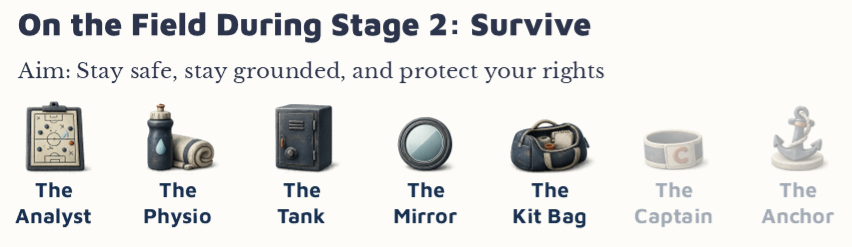
The aim of this stage is to stay safe, stay grounded, and protect your rights. You may still be in the relationship. You may be navigating separation, legal proceedings, custody disputes, or the immediate aftermath of leaving. The environment is volatile and the demands on you are relentless. This is the stage where the squad needs to be strongest because the pressure is at its highest.
On the field:
- The Analyst. Your thinking is under constant assault from the situation around you. Legal decisions, co-parenting conflicts, financial stress, and emotional turmoil all compete for cognitive space. The Analyst’s game play during Survive shifts from naming the abuse to helping you think clearly through the chaos of responding to it. They help you prioritise, see through manipulation in real time, and make decisions when everything feels urgent.
- The Physio. Emotional dysregulation peaks during Survive. Court documents trigger you. Interactions with your ex destabilise you. Your children’s distress activates a protective response that has nowhere safe to land. The Physio during this stage is essential infrastructure. They are the person you call before you send the message you will regret. The practice you turn to when the anger or despair threatens to take over. The outlet that keeps you functional when everything in you wants to collapse or explode.
- The Tank. You are carrying more during this stage than at any other point. Legal strategy, emotional pain, fear for your children, anger, exhaustion. The Tank holds all of it. During Survive, the Tank also serves a protective function: it is the space where you can say the things that cannot be said anywhere else, the things that would be used against you if they were heard by the wrong person.
- The Mirror. The intensity of this stage can make you feel like you are disappearing. The crisis consumes everything and your sense of self gets buried under the weight of daily survival. The Mirror keeps you connected to who you are underneath all of it. Even a brief moment of genuine vulnerability with this person can reset your internal compass when the pressure has pulled it off course.
- The Kit Bag. You will spend significant stretches of this stage alone. The periods between legal appointments, between handovers, the nights when the house is quiet and the weight lands. The Kit Bag gives you something structured and purposeful to work with during those hours. Frameworks for managing triggers. Exercises for grounding. Resources that remind you of the bigger picture when the immediate crisis narrows your vision.
On the bench:
- The Captain. There may be moments during Survive where you need someone to push you to take a step you are avoiding. A phone call you keep putting off. A boundary you need to set. The Captain is available for these moments, though the primary need at this stage is stability.
- The Anchor. A ten-minute conversation about something normal can reset your state during Survive. If you have access to someone who holds ordinary ground, lean into it briefly when you can.
In the stands:
- The Agent and the Fan. Rebuilding identity and reconnecting with enjoyment are premature during Survive. Your energy is directed at getting through. These players arrive when the immediate danger has passed.
Scoreboard: your team is working when...
- You are making clear decisions under pressure, even if they are difficult.
- You have at least one person who knows the full picture and can help you think through legal and practical challenges.
- You are not acting on impulse. The message you wanted to send at midnight gets reviewed by a trusted person first.
- You are still functioning: getting to work, caring for your children, managing the essentials of daily life.
- Even in the worst stretches, you know there is at least one person or one resource you can turn to.
Stage 3: Recover
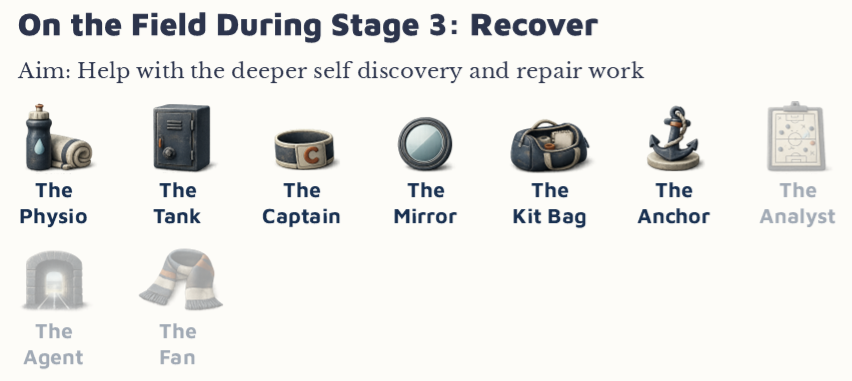
The aim of this stage is the deeper work. The immediate danger has passed. The acute crisis has stabilised. And now the full weight of what happened begins to land. Recover is where men often feel worse before they feel better, because the survival mechanisms that carried them through Stage 2 begin to dissolve and the emotions they were holding at a distance come rushing in.
This stage requires the broadest support because the work is the most demanding.
On the field:
- The Tank. The material surfacing during Recover is often the heaviest of the entire journey. Shame that has been buried. Grief for the relationship you thought you had. Anger that was too dangerous to feel while you were still in it. The Tank’s game play during Recover is holding space for all of this without rushing you through it.
- The Physio. Emotional intensity in Recover can match or exceed what you felt during Survive, and it catches many men off guard. You expected to feel better by now. The fact that you feel worse is disorienting. The Physio during this stage helps you understand that this is the process working, and gives you the tools to move through it without being consumed by it.
- The Mirror. Deep vulnerability is the work of this stage. You are processing things you may have never spoken about. You are confronting parts of yourself that the abuse distorted. The Mirror receives all of it and reflects you back to yourself honestly, which is how you begin to rebuild a relationship with who you actually are.
- The Captain. This is where the Captain becomes essential. The deeper work requires courage. There are moments where you will want to stop, retreat, or avoid the material that needs facing. The Captain’s game play during Recover is holding you to the work. They push you forward because they believe you are capable of getting through it, even when you are not sure yourself.
- The Kit Bag. Structured exercises, frameworks, and resources give you continuity between sessions with your therapist or coach. The Kit Bag keeps the work moving during the hours you are alone and gives you something concrete to turn to when the weight feels unmanageable.
- The Anchor. During Recover, the risk of your entire identity collapsing into the recovery process is real. Every conversation is about the abuse. Every thought circles back to what happened. The Anchor’s game play during this stage is pulling you out of that loop. A conversation about something ordinary. An activity that has nothing to do with your recovery. The Anchor reminds you that you are a person with a life, and that life continues to exist alongside the work you are doing.
On the bench:
- The Analyst. Your thinking is clearer by this stage. The Analyst may still be needed when old patterns of confusion resurface or when a new situation triggers the familiar fog, but the heavy untangling work is largely behind you.
- The Agent. Identity reconstruction begins to emerge in Recover. You start to ask who you are becoming. The Agent can begin to support that work, though it becomes central in Thrive.
- The Fan. Lightness begins to re-enter your life. Occasional moments of genuine enjoyment are part of healing. The Fan can make brief appearances as the foundation stabilises.
Scoreboard: your team is working when...
- You are engaging with the deeper emotional work, even when it is painful.
- You are beginning to understand how the abuse shaped your beliefs, your behaviour, and your sense of self.
- You have moments of clarity about who you were before this and who you want to become.
- You can spend time doing normal things without feeling guilty for not “working on recovery.”
- You are starting to feel like a person again, not just a case or a crisis.
Stage 4: Thrive
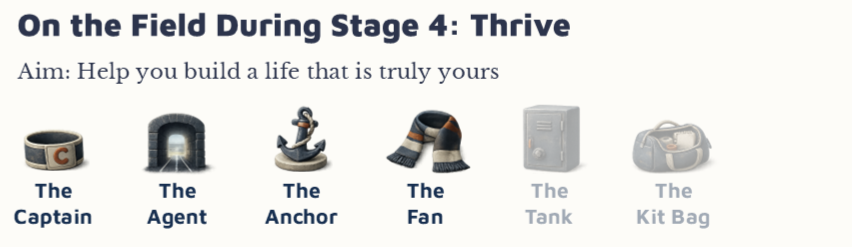
The aim of this stage is to build a life that is yours. The crisis is behind you. The deeper therapeutic work has been done or is well underway. You are reconnecting with your identity, your purpose, your capacity to enjoy things, and your sense of direction. Thrive is where the team shifts from a recovery squad to a life squad. The players on the field are the ones who help you build forward.
On the field:
- The Captain. Direction, challenge, and accountability. The Captain’s game play during Thrive is helping you set standards for the life you are building and holding you to them. This is no longer about getting through. It is about getting somewhere.
- The Agent. This is the Agent’s stage. Identity, purpose, agency, and direction are the central work of Thrive. The Agent helps you shape what comes next. They help you reconnect with the parts of yourself the abuse buried and discover new parts that are emerging on the other side of it.
- The Anchor. The Anchor’s role matures in Thrive. They are no longer holding ground during a crisis. They are part of the normal, stable, grounded life you are constructing. Their presence is the evidence that ordinary life exists and that you belong in it.
- The Fan. Joy, lightness, social connection, and laughter become essential parts of a full life. The Fan is no longer a luxury. They are a feature of a life worth living. Reconnecting with enjoyment is one of the clearest signs that you have come through the worst of it.
On the bench:
- The Tank. Old material can resurface. New challenges may echo old patterns. The Tank remains available for the moments when you need a safe space to process something that catches you off guard.
- The Kit Bag. Resources continue to support growth and maintenance. You may return to specific frameworks or exercises as needed, particularly when navigating new relationships or situations that trigger old responses.
In the stands:
- The Analyst and the Physio. Your thinking is your own and your emotional regulation has stabilised. These players have done their work. If they are needed again, they can be called back up, but the day-to-day need has passed.
Scoreboard: your team is working when...
- You have a sense of direction. You know what you are building toward.
- Your identity is no longer defined by what happened to you. It is part of your story, and it is not the whole story.
- You are enjoying things. Genuinely. Laughter is real. Social connection feels natural.
- You can navigate new challenges, including ones that echo old patterns, without being pulled back into crisis.
- You are making decisions about your life based on what you want, not on what you are afraid of.
Players Already in Your Squad Who Need Managing
Your existing relationships do not disappear when you enter recovery. The people who were in your life before this started are still there, and many of them want to help. The challenge is that some of them bring energy that is valuable at certain stages and needs careful management at others.
This is not about cutting people from your life. It is about helping them understand how to play alongside you during this period.
You can keep a person in your squad and ask them to dial back one behaviour while dialling up another. A simple, honest conversation goes a long way. Most people, when told clearly what you need, are relieved to have the direction. The difficulty is rarely their willingness. It is your willingness to ask.
The Warrior
The Warrior is fiercely loyal. They are angry on your behalf and they want to fight for you. Their loyalty is real and their energy comes from genuine care.
During Educate and Survive, the Warrior needs a tight leash. If court proceedings are underway, any action they take toward your ex, her family, or mutual connections can create legal complications and undermine your position. Tell them clearly what you need: presence, loyalty, and restraint. In Recover and Thrive, you can let the reins off gradually. Their fierce energy becomes something you can lean into. Keep them aware of anything that could affect custody or legal standing, and channel their willingness into support.
The Party Friend
The Party Friend lives loud. They drink, they go out, and their instinct when you are hurting is to pull you out of it with a big night.
During Educate and Survive, be honest with them. Tell them you need to step back from that part of your life for a while and that you will be back later in the journey. In Recover, an occasional night out can be healthy, as long as you are honest with yourself about whether you are enjoying it or using it to avoid something. In Thrive, the Party Friend comes back into fuller rotation. You are approaching the friendship with fresh eyes now, aware of your vulnerabilities, and engaging from a place of strength.
The Fixer
The Fixer wants to take over. They make calls, handle logistics, and solve problems on your behalf. They mean well, and the effect of sustained fixing is that it keeps you in a position where someone else is running your life.
During Survive, there are specific moments where practical rescue is genuinely needed. Accept it when it is. Give them something specific and contained to help with, and set clear limits around everything else. In Recover and Thrive, be direct: what you need now is their trust in your ability to handle things. You will ask for help when you need it, on your own terms.
The Gossip
The Gossip cares about you and they talk. What you share with them has a meaningful chance of reaching other people.
During Educate and Survive, the Gossip should not have access to detail. Anything that reaches your ex’s circle or wider social networks during this stage can be used against you. Keep it general. In Recover and Thrive, you can share selectively, knowing it will travel. Sometimes that is useful. The key is that the sharing is deliberate, not accidental.
The Minimiser
The Minimiser tells you to toughen up, get over it, move on. Their energy is blunt and their patience for emotional difficulty is low. They are often coming from their own discomfort with the topic.
During Educate and Survive, the Minimiser can do real harm. You are already doubting yourself. Their voice lands on top of the doubt the abuse installed, and together they become very loud. Limit your exposure during these stages. In Recover and Thrive, as your confidence rebuilds, you can engage more comfortably. Their bluntness may even be useful occasionally, but only because your foundation is strong enough to absorb it.
When a Player Lets You Down
It will happen. Someone you trusted will say the wrong thing. The Tank will leak. A friend you chose as your first conversation will respond badly. The person you thought was your Anchor will pull away when the reality of your situation becomes uncomfortable for them.
People are human. They carry their own limitations, their own discomfort with difficult material, and their own lack of understanding about what you are going through. Some of the time, a player letting you down is a signal that they are in the wrong position. They may still belong in your squad, just in a different role. A person who cannot be your Tank might still be a solid Anchor. A person who is an unreliable Physio might be an excellent Fan at a later stage.
Some of the time, a player letting you down is the result of unclear expectations. If you have not told someone what you need from them, they will fill the gap with their best guess, and the gap between what you needed and what they offered is where the disappointment sits. Before you write someone off, ask whether you communicated clearly enough. If you did, and they still fell short, that is important information about where they can and cannot play.
Adjusting the squad is part of the process. Moving a player to the bench. Bringing someone new onto the field. Accepting that a person you hoped would fill a role is not able to. These are difficult decisions and they are also acts of agency. You are building a team that works for you. That means making changes when it does not
Final Thoughts
You do not need fifteen people. You do not need a perfect team. You need the right functions covered by people and resources you trust, and you need those functions to match where you are in your journey.
Scan your life. Look at who is already there. Look at what each person brings and where it fits. A man with three Anchors and no Analyst has company but no clarity. A man with a strong Kit Bag and no Mirror has resources but nowhere to be vulnerable. The framework helps you see the shape of what is around you and what is missing.
Fill the gaps deliberately. That might mean finding a therapist. It might mean reaching out to a friend you have not spoken to in months. It might mean picking up a book or subscribing to a channel that gives you frameworks to work with alone. It might mean having an honest conversation with someone about what you need from them right now.
Revisit the framework as you move through the stages. Every few months, look at your team and ask whether the right players are still on the field. What you needed in Survive is different from what you need in Thrive. Let the team change. Let players come on and off the field as the game changes.
The act of building this team deliberately is itself part of reclaiming what was taken from you. Coercive control stripped away your connections, your confidence in others, and your belief that people could be trusted to show up. Building a support network, choosing who plays each position, asking for what you need, managing what does not serve you, is an act of agency. It is you deciding how your recovery works. It is you taking control of the environment around you.
You are building this team. You choose who plays. That choice is part of getting your life back.