How to Have More Than the Emotional Range of a Spoon
7th May 2026
Men Are Allowed Only A Few Emotions
If you are a man, you have been handed a fraction of the emotional spectrum and told it is all you need.
You have a small set of feelings you are permitted to show in public, a slightly larger set you can get away with in private, and a significant portion of your internal experience that the world around you has decided is off-limits.
The result is that most men are operating with less emotional data than they have access to, and making decisions about their lives, their relationships, and their wellbeing with an incomplete - logical only - picture.
There is a deeper problem underneath the cultural one.
Most men confuse feeling an emotion with acting on one.
When someone says “get in touch with your feelings,” what a man often hears is: feel something and then do something about it. Express it. Show it. Put it on display. And because many of the emotions he feels are ones the culture has told him are unacceptable to display, his instinct is to reject the idea and suppress his emotions entirely.
If he cannot act on the feeling safely, he decides the safest option is to not feel it at all. That logic is understandable. It is also wrong. Feeling an emotion and acting on it are two entirely separate things, and the failure to understand that distinction is at the root of how men lose connection to their own internal world.
If you have been through an abusive relationship, the problem is compounded further. You started from a culturally restricted range and then the abuse compressed it further - until the number of emotions you could safely access shrink to almost nothing. Entire categories of feeling were shut down because the environment punished them. You are not choosing to feel numb, or flat, or limited. Your system adapted to survive, and the cost of that adaptation is the loss of the full range of experience that makes life feel like living.
The answer to all of this is simpler than the self-help industry makes it sound.
Process all of your emotions. Display externally what you choose to. And act from a place of informed choice that draws on both logic and emotion.
Because a decision grounded in both is more powerful and more accurate than logic alone. That is what “being in touch with your feelings” actually means. It is not about becoming more emotional. It is about becoming more informed. The rest of this article is the journey to understanding what it means to process and act only from a place of informed choice.
The Bias You Are Swimming In
There is a persistent, deeply embedded cultural assumption that male emotion is inherently dangerous.
It is so pervasive that most people do not recognise it as a bias at all. It shows up in how boys are raised, in how men are depicted in media, in how support services frame male emotional experience, and in how content designed to help men process their feelings still arrives packaged with warnings about what might happen if they express too much.
Even artificial intelligence, trained on the sum of human language, reproduces the bias automatically. Ask an AI to help a man process his emotions and it will insert guardrails about “not dumping on others” and “not misfiring.” The machine learned the bias because the culture that produced the training data carries it in every sentence.
The bias says: a man who feels is a man who is one step from losing control. A man who expresses anger is a man who is about to become violent. A man who cries has failed at being a man. A man who shows vulnerability has surrendered his strength.
The implicit message is that your feelings are a risk to be managed, preferably in private, preferably in silence, and ideally not at all.
This article takes a different position. A man who feels is a man who is receiving data about his world. A man who processes that data, who understands what his emotions are telling him, who separates the experience of feeling from the decision of how to respond, is a man who is operating with the full instrument panel available to him.
The bias tells you to shut the panel down. This article is about turning it back on and arming yourself with a powerful set of data inputs previously denied to you.
There Is No Such Thing as Good & Bad Emotions
The missguided concept of “positive” and “negative” emotions has done enormous damage to society, and it has done particular damage to men.
The framework sounds reasonable on the surface. Some emotions feel good and can lead to culturally perceived positive behaviours. Some emotions feel bad and can lead to culturally negative behaviours. So we label the pleasant ones as positive and the unpleasant ones as negative.
In doing so, we create a moral judgement around internal experience that has no business being there. When you label an emotion as “negative,” two things happen simultaneously.
- You shy away from it, treating it as something to be eliminated, and in doing so you lose the information it was carrying. And;
- You feel shame for experiencing it in the first place, because you are now not just feeling fear or jealousy or sadness, you are feeling something you have been told you are bad for feeling.
Whoever labelled emotions as positive and negative did the world a disservice. They told people that half of their internal experience was unwelcome.
The damage falls disproportionately on men. Look at the emotions typically classified as “negative”: anger, fear, sadness, anxiety, shame, guilt, disgust, envy. Now look at the cultural permission structure for men. The overlap between “negative emotions” and “emotions men are told to suppress” is almost total.
A man who accepts the positive/negative framework is being told to reject the vast majority of what he is already forbidden to express. The band gets narrower and narrower until he is operating on almost nothing.
There is also a revealing asymmetry here. When a woman expresses anger, the cultural response can often be curiosity and care: what drove you to that? When a man expresses anger, the cultural response is caution and containment. The same emotion, carrying the same data, can be treated as a signal worth exploring in one person and a threat to be managed in another. That is not a reflection of the emotion. It is a reflection of the bias.
The reality is that all emotions are neither good or bad. They are simply signals about your internal and external environment.
Every emotion you feel is a signal about something: your environment, your relationships, your boundaries, your needs, your history, your body. Fear signals that something threatens your safety. Anger signals that a boundary has been crossed. Sadness signals that something has been lost. Jealousy signals that something you value feels at risk. Guilt signals that your behaviour has not aligned with your values.
None of these are good or bad. All of them carry information that, if processed, makes you more capable of navigating the world you are in.
The critical distinction that the positive/negative framework misses entirely is the difference between feeling an emotion and acting on it.
You can feel greed. If you act on greed without awareness, that can cause harm. If you feel greed and examine it, ask yourself where it is coming from, what it is telling you about what you want or what you feel you lack, it becomes useful information that you can respond to thoughtfully. The emotion is never the problem. Unexamined action is the problem. And by labelling the emotion itself as “bad,” we ensure it never gets examined (processed) at all. That's the path to emotional maturity.
What Happens When You Are Told Half Your Feelings Are Wrong
When you absorb the missconception that a significant portion of what you feel is unacceptable, you learn to compress it. This happens through two mechanisms, and both of them rob you of the data the emotion was trying to deliver.
- The first is suppression. You feel something and the internal response is immediate: I should not be feeling this. You push it down. You disconnect from it. You move on as though it did not happen. The emotion does not go away. It goes underground, where it accumulates and surfaces later in ways you do not recognise: as exhaustion, as numbness, as a short fuse that seems to come from nowhere, as a body that holds tension it cannot explain, as a flatness that settles across your days without an obvious cause.
- The second is relabelling. You feel something outside the permitted range and your mind reclassifies it as something acceptable. Fear becomes anger, because anger is allowed. Hurt becomes frustration, because frustration is tolerable. Sadness becomes withdrawal, because withdrawal looks like composure. Loneliness becomes independence, because independence is rewarded. The original emotion is never processed because it was never accurately identified. You responded to the wrong signal because you renamed it before you could read it.
Both mechanisms serve the same function: they keep you operating within the band the culture has defined as acceptable for a man.
And both carry the same cost. The information the emotion was carrying, the data it was trying to give you about yourself, your relationships, and your environment, is lost. You are making decisions with an incomplete picture because a significant portion of your own experience has been suppressed or mislabelled before it reaches your awareness.
The Cultural "Shackles" on Male Emotion
A note before we continue. I am not a psychologist. I am a trauma-informed coach with lived experience of long-term coercive control. The frameworks in this article are drawn from that experience, from coaching practice, and from published research (Cowen & Keltner, 2017). They are designed to support your understanding, not to replace professional guidance. If you are working with a therapist, bring this material to them.
Research identifies at least 27 distinct categories of human emotion. The graphic below maps every one of them against what a man is culturally permitted to display, from freely acceptable through to shunned.
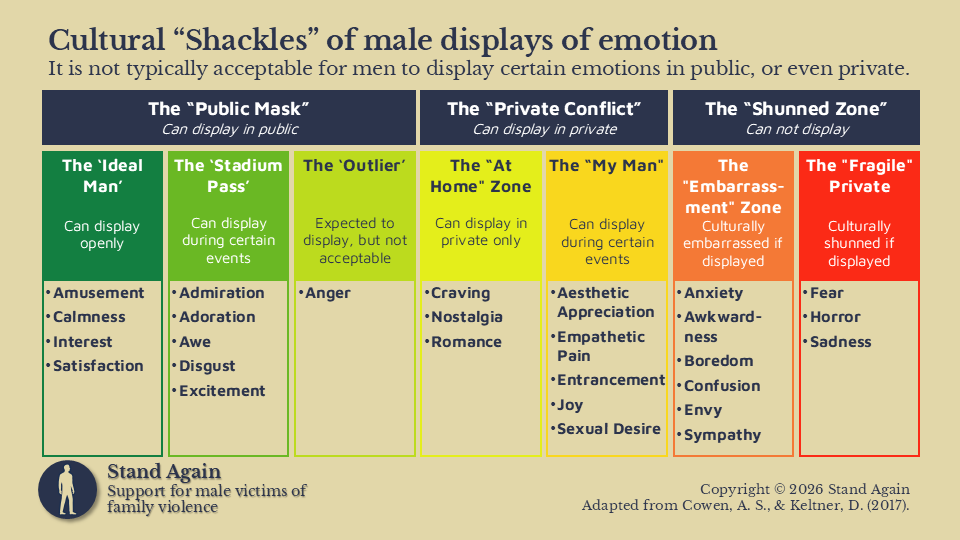
What the graphic reveals is how narrow the band actually is. Four emotions sit in the “Ideal Man” zone where open display carries no cultural penalty: amusement, calmness, interest, satisfaction. These are the emotions that make a man appear composed, capable, and steady. A handful more get a situational pass, acceptable at a football match, during a victory, in a moment of collective energy. And then there is anger, sitting alone in a category that captures one of the most damaging contradictions in masculine culture: it is the emotion men are expected to perform and simultaneously punished for expressing.
Everything else is regulated. What most people miss when they talk about men and emotional restriction is that the regulation does not only apply to the “difficult” emotions. Joy, excitement, aesthetic appreciation, empathetic pain, sexual desire, these all sit in restricted zones. A man who shows visible delight, who is openly excited, who is physically relaxed and at ease, who shows tenderness, is culturally policed for it. The restriction is not just “men can’t show sadness.” It is “men can’t show joy freely either.” The full 27 are compressed into a handful, and the compression applies across the entire spectrum, not just the end the culture calls “negative.”
This is the emotional world you were handed before you had a choice in the matter. And if you are a man who has been through an abusive relationship, this was your starting point. The abuse did not take the full range from you. The culture already had.
What Abuse Does to What Was Already Restricted
If the culture narrows your emotional range, abuse compresses it to almost nothing.
Inside a coercive relationship, every emotion becomes a risk assessment. Expressing anything, positive or negative, carries the potential for punishment. Joy gets sabotaged. Vulnerability gets weaponised. Anger triggers retaliation. Fear confirms to the abuser that her tactics are working. One by one, the man tests each emotion against the environment, finds it to be dangerous, and shuts it down.
What remains is a survival set: the "Prison", the smallest number of emotional states he can operate on without triggering further harm.
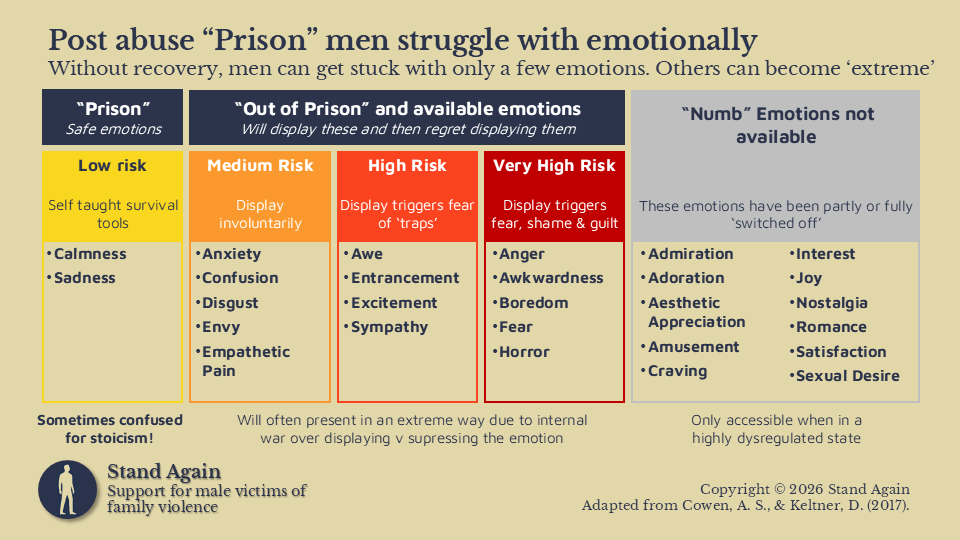
The second graphic above maps the 27 emotions against the post-abuse reality, and the picture is stark.
Twelve of the twenty-seven categories are typically no longer available at all. They have not been suppressed. They are genuinely absent. Admiration, adoration, amusement, joy, interest, satisfaction, romance, craving, nostalgia, aesthetic appreciation, sexual desire. The neural pathways that produce these experiences have been 'disrupted' by years of living in an environment where none of them were safe. The man does not choose to not feel joy. Joy is no longer accessible to him. He is not numb by choice. He is numb because the system that produces richness of feeling was disconnected and dysregulated for his survival.
What remains divides into risk categories. Calmness and sadness sit at low risk, the survival tools a man can deploy - not safely, they still carry risk, but the lowest of triggering further harm.
Calmness in this context is worth examining carefully because it is frequently confused with stoicism. It is not stoicism. Genuine stoic philosophy still processes emotions and responds from a place of awareness. What this man is doing is deploying a mask of composure because it is the only safe presentation available to him. He looks steady from the outside. From the inside he is operating on two emotions out of twenty-seven. That is not strength. It is a survival state, and it is dangerous because it can persist for years after the relationship ends if nobody names it for what it is.
The emotions categorised as high and very high risk tell the rest of the story. These are the feelings that, when they surface, trigger an internal war between the impulse to express and the conditioning to suppress. The result of that war is often extreme presentation: anger that arrives as an explosion because it was held at bay until the pressure became unbearable, fear that manifests as paralysis or panic, awkwardness that reads as instability because the man is fighting himself in real time. These are not character flaws. They are the visible evidence of a system under strain, a man trying to feel with an instrument that was damaged by the environment he lived in.
Recovery: Processing Without Acting
Recovery is where the earlier categories dissolve. The cultural permissions, the post-abuse risk assessments, the division of emotions into acceptable and forbidden: all of it is replaced by a single principle.
Every emotion you feel is data. Process it. Understand it. Then choose what to do with it.
The concept that makes this work, the one most men were never taught, is that processing an emotion and acting on it are different things. Processing means letting the emotion exist inside you. Giving it space. Examining what it is telling you: where it came from, what triggered it, what it is signalling about your internal state or your environment. Processing is internal. It happens in your own mind and body. It does not require an audience. It does not require expression. It requires only your willingness to sit with what is present and understand it.
Acting on an emotion is an external event. It is a behaviour. It is what you do in the world as a result of what you feel. And between the processing and the acting, there is a space where your decision lives. That space is where you choose whether to express the emotion, how to express it, when to express it, and whether to express it at all. Some emotions need to be expressed. Righteous anger at a boundary violation deserves a clear, proportional response. Some emotions need to be held and examined. Jealousy that arrives in a new relationship may be signalling something real about the situation, or it may be a scar from the old one. The processing tells you which it is. The action follows the understanding.
This is what separates a man who is in touch with his feelings from a man who is controlled by them. Both feel. One processes and then chooses. The other reacts and then deals with the consequences.
And there is a third man, the one who suppresses everything and makes decisions on logic alone. He believes he is operating cleanly, free from the noise of emotion. He is not. He is operating with missing data, and his decisions are poorer for it. A choice grounded in both logic and emotion is more accurate, more grounded, and more powerful than logic alone. That is the capability you are rebuilding.
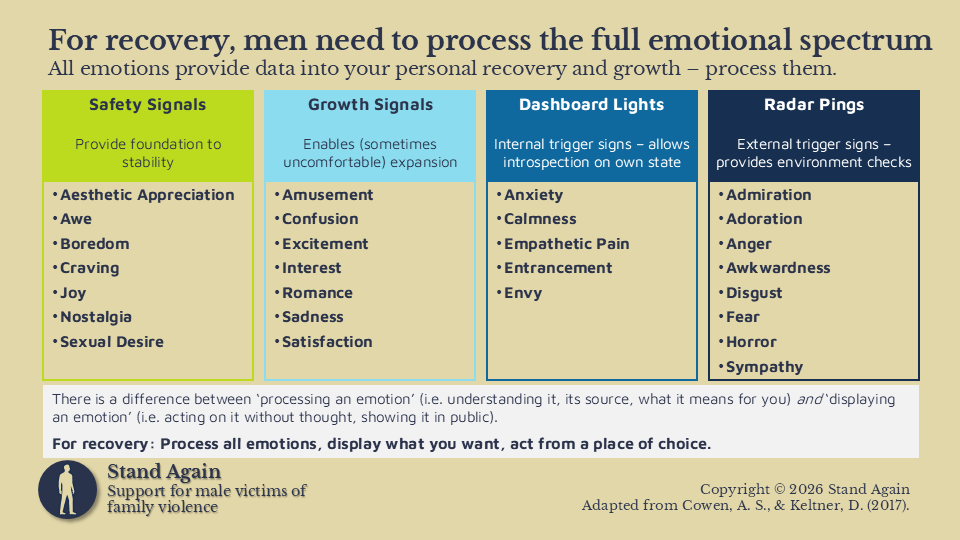
The third graphic above maps the 27 emotions into four functional categories. These are no longer about permission or risk. They are about purpose. What is this emotion telling you, and what does it ask of you?
Safety Signals
Aesthetic appreciation, awe, boredom, craving, joy, nostalgia, sexual desire. When these emotions return, they are telling you something profound: you are safe enough to feel them. For a man coming out of abuse, the reappearance of boredom, genuine boredom where you are not productive and you feel fine about it, is one of the clearest markers that the prison is behind you. These emotions provide the foundation for stability. Their presence means the survival system is standing down. Their return is evidence of recovery, and it should be welcomed, even when it feels unfamiliar or unearned.
Growth Signals
Amusement, confusion, excitement, interest, romance, sadness, satisfaction. These emotions enable expansion. Some of them are uncomfortable, confusion and sadness in particular, and that discomfort is the feeling of your world getting larger. Confusion means you are navigating territory you have not been in before. Sadness means you are processing something that mattered. Interest means something is pulling you forward. These are the emotions of a life in motion. Welcome them even when they feel heavy, because heaviness during growth is the weight of something being built.
Dashboard Lights
Anxiety, calmness, empathetic pain, entrancement, envy. These are signals about your own internal state. They call for you to look inward before you act. Anxiety is telling you something feels threatening, and you need to assess whether the threat is real or a residue from old patterns. Calmness needs honest checking: are you genuinely at peace, or have you deployed the composed problem-solver mask because something activated you and you defaulted to the only safe emotional presentation you know? Empathetic pain needs examining with particular care for men coming out of coercive control: are you feeling someone else’s distress because you genuinely care about them, or because you spent years conditioned to prioritise everyone’s needs above your own? The dashboard light asks you to look at yourself honestly. That honest look is the processing.
Radar Pings
Admiration, adoration, anger, awkwardness, disgust, fear, horror, sympathy. These are signals about your environment. Something is happening around you that requires your attention. Anger means a boundary has been crossed. Fear means your safety may be in question. Disgust means something in your environment does not belong in your life. Admiration means you are recognising something you value and want to move toward. Awkwardness means the social terrain has shifted and you need to recalibrate. Sympathy asks if you are actually responding to what is happening around you or running on old patterns. The radar ping asks you to look outward and assess what is happening before you choose your response.
Working with what arrives
When any emotion arrives, the process is the same. Feel it. Name it as accurately as you can. Determine which category it belongs to: is it telling you about your safety, your growth, your internal state, or your environment? Then ask the honest question. Is this emotion a legitimate response to what is happening right now? If it is, choose your action. Express it, set a boundary, lean in, walk away, hold your ground. The response is yours and it comes from a place of understanding. If the emotion does not match the reality, if the anger is disproportionate, if the fear is a ghost from an old pattern, if the empathetic pain is people-pleasing dressed as caring, then the signal is pointing you toward work that needs doing. Inner work on the wound or the pattern that produced the mismatch. External work on the boundary or the environment that triggered it. Either way, you are using the emotion as what it always was: data.
A Practical Tool: Name, Own, Place, Choose
This framework works in real time. It works in the heat of the moment and it works in quiet reflection afterward.
Name it. What are you actually feeling? Move past the default label. Be specific. You are not just angry. You might be disappointed, afraid, hurt, or all three at once.
Own it. Give yourself permission to feel it. It is not weak, it is not wrong, it is not dangerous. If shame arrives alongside the emotion, notice that too. The shame was installed. The emotion is yours.
Place it. Separate the internal feeling from the external expression. You feel this. You do not have to show it yet. You do not have to act on it yet. Holding it long enough to understand it is where your agency lives.
Choose. Now decide what to do. Express it, hold it, act on it, let it pass, use it as a prompt for inner work. The decision is yours. You are choosing from awareness, and that is a fundamentally different way to move through the world.
Process all emotions. Display what you choose. Act from a place of choice. That is what it means to feel as a man.
Final Thoughts
Culture gave you a fraction of your emotional range and told you it was all you needed. If you have been through abuse, the relationship took what the culture left. The result is a man making decisions with incomplete data, navigating a complex world with a restricted instrument panel, and wondering why he feels flat, disconnected, or unable to access the parts of life that are supposed to feel rich.
Recovery is the process of bringing the full panel back online. Learning that every emotion is legitimate data. Understanding that feeling and behaviour are separate acts and that the space between them is where your power lives. Recognising that the shame you carry about certain emotions was installed by a culture and reinforced by an abusive environment, and that it can be uninstalled through the deliberate, patient work of reconnecting with your own experience.
I have written about that process in depth in Reconnecting With Your Feelings After Abuse, which documents what it looks like to rebuild your relationship with your emotional range after long-term coercive control. If this article resonated, that book is the next step.
The full emotional spectrum is yours. It has always been yours. Reclaiming it is part of reclaiming your life.