💛 Help Stand Again support male survivors – Donate here
❤️ Wear your support proudly – Visit our shop
💛 Help Stand Again support male survivors – Donate here
❤️ Wear your support proudly – Visit our shop
Abuse doesn’t just happen. It follows a pattern. A predictable sequence that — once understood — can be interrupted, addressed, and eventually left behind.
At its core, abuse is a psychological chain reaction
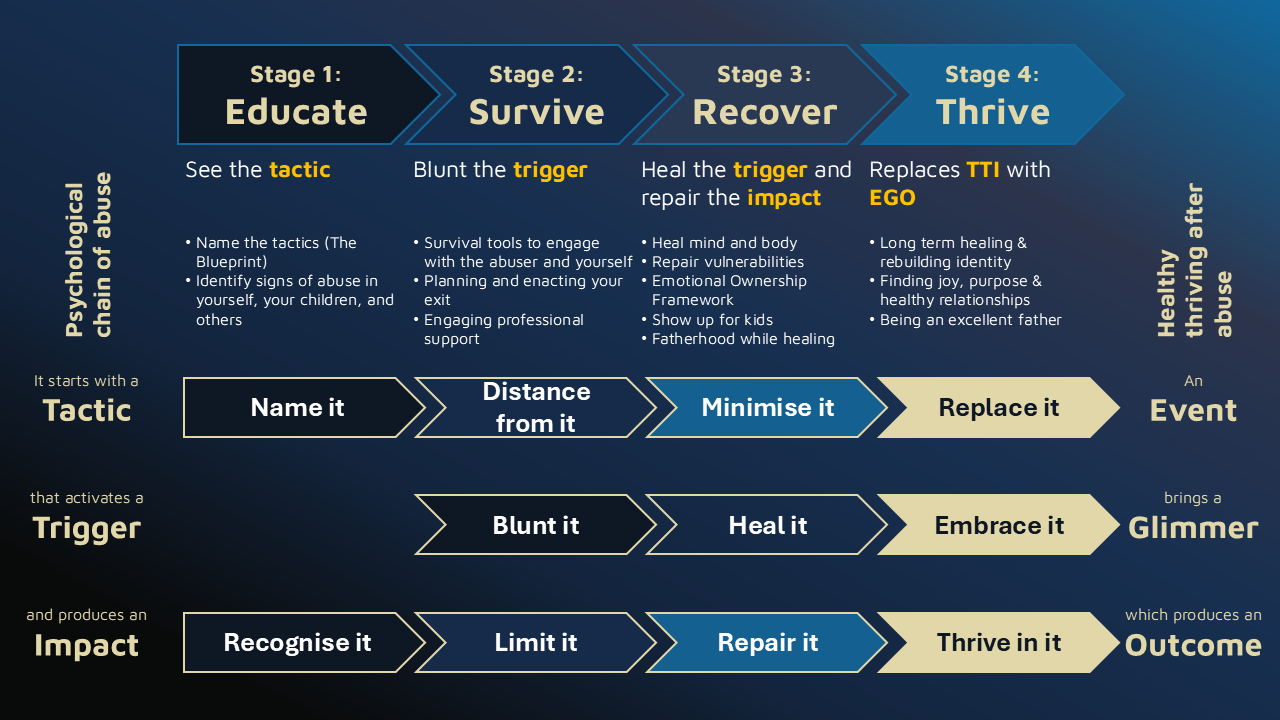
It starts with a tactic that activates a trigger, and produces an impact.
Understanding this chain — how each part functions — is the first step toward recovery. Because if you can see how abuse works, you can start to loosen its grip.
Not all tactics operate the same way. Some strike once. Others repeat. Some train you without you realising it. And others arrive in carefully timed clusters.
That’s why, as you move through the Blueprint — the resource that lays out all the tactics you see in family violence against men — understanding how these tactics show up can be important to avoid being overwhelmed by them.
Tactics are used in five distinct pattern types:
This is where the abuse lands. It’s the internal vulnerability the tactic touches. And it’s deeply personal.
These triggers don’t mean the abuse was your fault — but they do reveal where past pain lives. Naming them helps you understand not just what happened to you, but why it was able to land the way it did — and where you may need to take responsibility for your own poor behaviours, patterns, or blind spots.
It’s the reason the abuse works. Not because you’re weak — but because you’re human. Triggers can come from:
This is what the abuser achieves — and what you’re left holding.
Sometimes it’s immediate: you back down. You change your plans. You go quiet. Other times, it builds over months or years: you lose your confidence, your clarity, your sense of self.
There are four main impacts:
Most abuse delivers more than one of these at a time. And the longer it goes on, the more you internalise it. You don’t just experience the abuse — you start to live by the rules it taught you.
Because you can’t fix this all at once — you can’t just snap your fingers and thrive. It takes stages — not because you’re slow, but because the abuse was deep.
You’re not just addressing what was done to you. You’re unlearning the things that made the abuse work in you.
Each stage in Stand Again is designed to interrupt one part of the abuse cycle:
This is the power of TTI when you put it into the four stages to thrive after complex abuse - you end up with a pretty powerful tool. Because it starts to reduce the “Complex” in complex trauma.
Thriving therefore doesn’t mean just avoiding abuse. It means replacing the old psychological chain — Tactic, Trigger, Impact — with a new one. Chains that’s rooted not in trauma, but in safety, connection, and choice.
That’s what EGO stands for: Event → Glimmer → Outcome.
This isn’t just a concept. It’s the goal of recovery. And it’s possible. But you can’t build EGO until you dismantle TTI. If you only change the impact — like forcing yourself not to fawn — but don’t address the trigger that caused it, then the pain just goes underground. You might stop reacting outwardly, but inwardly, the shame still festers.
This requires full repair — tactic, trigger, and impact. Only then can you begin to build a different nervous system pattern. One where you don’t just survive. You respond. You choose. You live.
That’s the shift from trauma story to thriving story. That’s the power of replacing TTI with EGO.
We need your consent to load the translations
We use a third-party service to translate the website content that may collect data about your activity. Please review the details in the privacy policy and accept the service to view the translations.