How TTI Helps Lawyers Identify and Document Coercive Control
28th March 2026 - Stand Again

The Legal Landscape
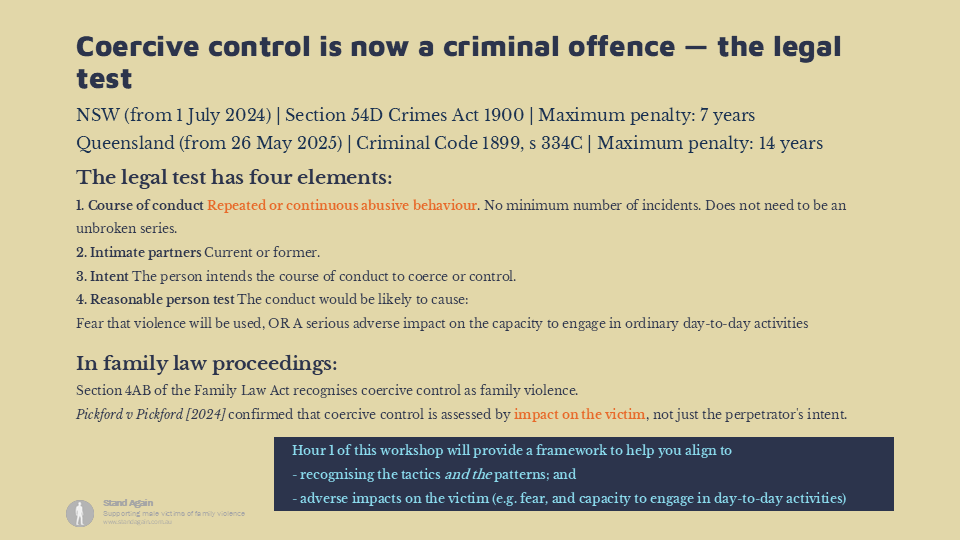
Coercive control is now a criminal offence in two Australian jurisdictions. In NSW (from 1 July 2024) under Section 54D of the Crimes Act 1900, with a maximum penalty of 7 years imprisonment. In Queensland (from 26 May 2025) under the Criminal Code, with a maximum penalty of 14 years. Section 4AB of the Family Law Act 1975 (Cth) also recognises coercive control as family violence, and Pickford & Pickford [2024] confirmed that coercive control is assessed by impact on the victim, not by perpetrator intent alone.
The criminal offence requires four elements: a course of conduct (repeated or continuous abusive behaviour), between intimate partners (current or former), with intent to coerce or control, where a reasonable person would consider the conduct likely to cause fear of violence or a serious adverse impact on the capacity to engage in ordinary day-to-day activities.
For lawyers, this creates a specific documentation challenge. You need to:
- identify what the abuser did,
- show that it formed a pattern, and
- evidence the impact on your client's capacity to function.
The TTI framework provides a structured way to do all three.
What Is the TTI Framework?
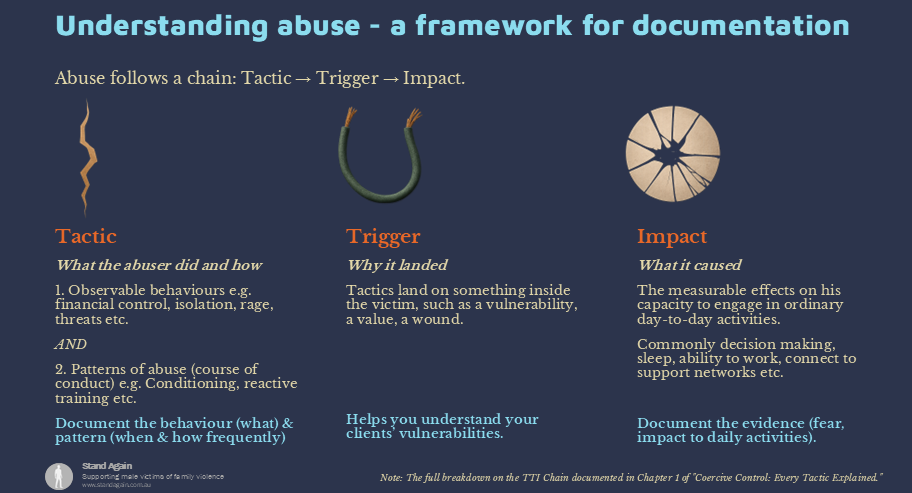
TTI stands for Tactic, Trigger, Impact. It is a framework developed through lived experience and work with victims of coercive control, designed to separate the external behaviours of the abuser from the internal experience of the victim and the measurable effects on their functioning.
Each instance of abuse follows a chain. The abuser deploys a tactic (the observable behaviour). That tactic lands on a trigger (an internal vulnerability, value, or wound inside the victim). The trigger activates and produces an impact (the effect on the victim's capacity to function).
[See the full TTI Framework described here]
For legal practice, TTI maps directly to the elements of the offence and provides a working structure for building a case.
How TTI Maps to Legal Practice
Tactic: What the Abuser Did
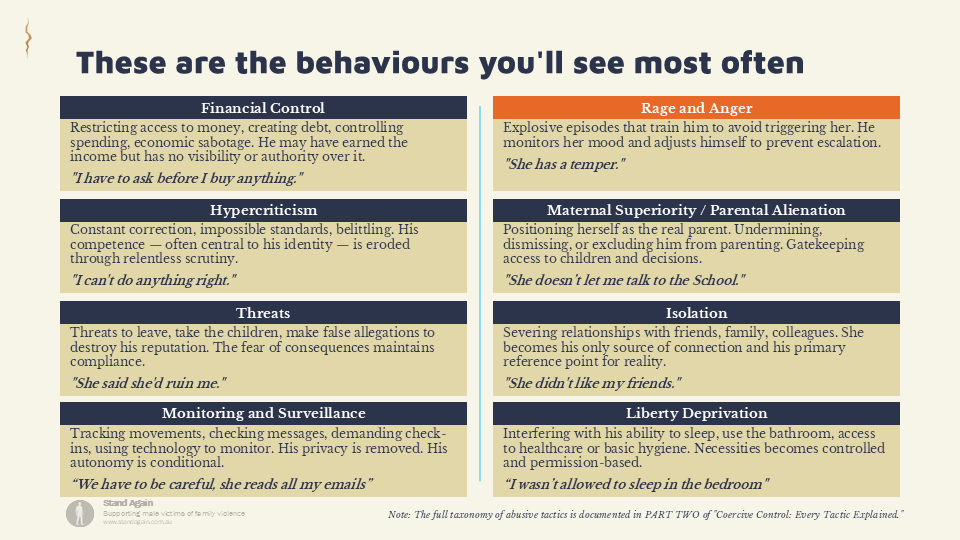
Tactics are the observable behaviours. Financial control, isolation, monitoring, hypercriticism, threats, undermining the victim's parenting, restriction of space and movement, rage, silent treatment.
These are what your client describes when they tell you what happened.
In legal terms, this is the conduct. It is what you document. It is what forms the factual foundation of the case.
A single tactic in isolation is an incident. The law does not require a single incident. It requires a course of conduct.
Which means tactics delivered in a pattern.
Documenting the tactic means documenting both what was done and how it was deployed.
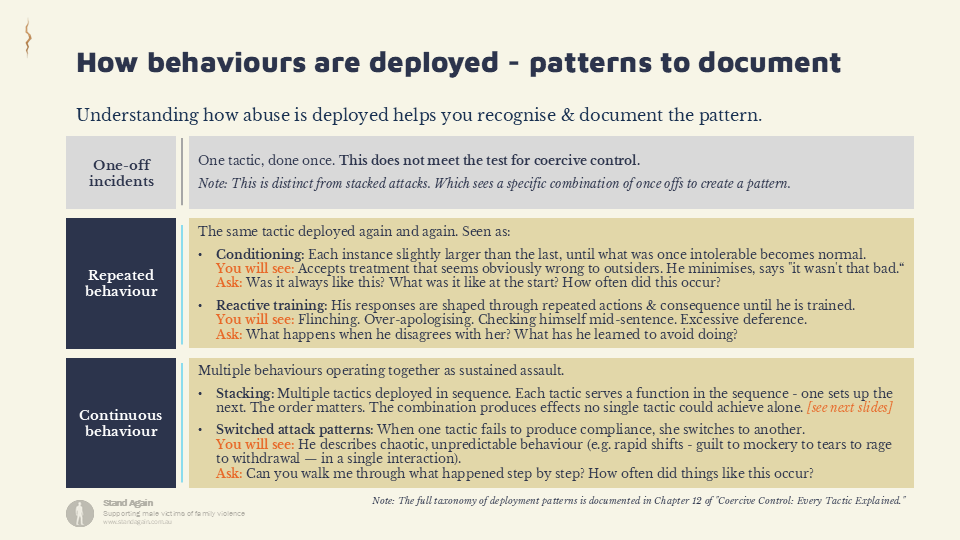
Tactics in coercive control are deployed through recognisable structures.
- Conditioning is the same tactic repeated, each instance slightly larger than the last, until what was once intolerable becomes normal. The threshold shifts.
- Reactive training shapes the victim's responses through repeated correction until they self-police without the abuser needing to act.
- Stacking deploys multiple tactics in sequence, where each tactic serves a function and one sets up the next. The order matters. The combination produces effects no single tactic could achieve alone.
- Switched attack patterns appear when one tactic stops working and the abuser shifts to another. What looks like chaotic, unpredictable behaviour is escalation with logic.
These deployment patterns are what distinguish coercive control from conflict. Conflict is situational. Coercive control is architectural. When you document your client's experience, you are looking for repetition, escalation, sequencing, and the cumulative weight of tactics working together.
Trigger: Why It Landed
Triggers are the internal vulnerabilities that explain why a particular tactic was effective against a particular person. A victim's identity as a provider, their fear of losing their children, their belief that good partners sacrifice, their need to be seen as competent.
This element is not part of the legal test. It does not need to be submitted as evidence. What it does is explain your client to you and, when necessary, to the court. It answers the questions that undermine credibility: why didn't they leave? and it can't have been that bad, surely?
Understanding your client's triggers gives you the context to present their story in a way that makes sense to a judicial officer. The same tactic that might have no effect on one person can be devastating to another, and the trigger is what explains the difference.
Impact: What It Caused
Impacts are the measurable effects on the victim's capacity to engage in ordinary day-to-day activities. This is the language of the legal test, and it is what the court assesses.
The impact categories that matter for documentation are:
- work (performance decline, missed days, job loss, difficulty concentrating),
- sleep (chronic disruption, exhaustion, hypervigilance),
- health (weight changes, somatic symptoms, chronic stress responses),
- social connection (lost friendships, isolation from family, withdrawal),
- parenting (undermined, excluded from decisions, reduced capacity to be present),
- decision-making (paralysis, deference, inability to act independently), and
- self-care (neglected health, missed appointments, poor nutrition).
These are documentable. These are what a court can assess. And critically, these are the effects that, when presented alongside the pattern of tactics that caused them, demonstrate the cause and effect relationship at the heart of a coercive control case.
The Core Insight
A pattern of tactics alone is not enough. A list of what the abuser did, without evidence of its effect, can be minimised. Impacts alone are not enough either.
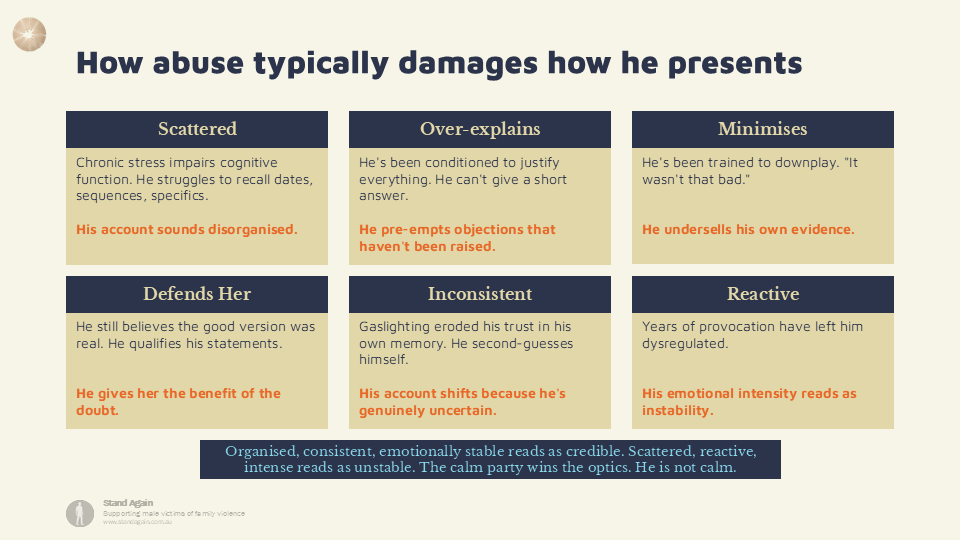
A client presenting with sleep disruption, work difficulties, social withdrawal, and impaired decision-making looks, on paper, like someone experiencing a mental health condition.
When documented together, the relationship between tactics and impacts becomes visible. Cause and effect. The pattern of behaviour produced these specific effects on this person's capacity to function. That is the case.
A Worked Example

A client describes that their partner controlled the household finances. They earned the income, but their partner managed all accounts, set spending limits, required justification for purchases, and had taken out a credit card in the client's name without their knowledge.
- Tactic: Financial control. The abuser restricted access to bank accounts, controlled all spending decisions, required approval for daily purchases, and accumulated debt in the client's name. The restriction deployed through conditioning. Early in the relationship, the abuser offered to "take care of the finances." Spending limits appeared gradually. Questioning led to conflict, so the client stopped questioning. What began as a shared arrangement became a structure where the client had no independent access to their own income and no visibility over their own financial position.
- Trigger: The client's identity as a provider. They valued being someone who could care for their family. The abuser exploited this by framing the financial control as being "for the family's benefit," making resistance feel like selfishness.
- Impact: The client could no longer purchase daily essentials like food and clothing without approval. They had no savings and no independent access to funds. Debt had been accumulated in their name without their consent, damaging their credit and creating financial obligations they did not know existed. When they recognised the relationship was abusive, they could not afford legal representation to leave.
For documentation, the tactic is what happened. The pattern is when, how often, and how it escalated. The trigger explains the client's response. The impacts are what the court assesses. Together, they form a chain that is specific, evidenceable, and aligned to the legal test.
What This Looks Like in an Affidavit
The following is an illustrative example of how the TTI framework might structure a paragraph in an affidavit. This is not legal advice or a template.
- - - - - - - - -
In approximately March 2019, the Respondent proposed managing the household finances.
When I raised concerns about losing access to my own income, the Respondent told me it was "for the family" and that my resistance was selfish. I relented.
By mid-2019, the Respondent had introduced spending limits and began requiring me to justify purchases, including groceries. When I objected, the Respondent became hostile and accused me of being financially irresponsible, despite my being the sole income earner. I stopped objecting.
By early 2020, I was required to seek the Respondent's permission before making any purchase for myself, including food and clothing. I had no independent access to any bank account and no visibility over our financial position. The Respondent refused my requests to see account statements.
In or around June 2020, I discovered that the Respondent had opened a credit card in my name without my knowledge or consent, accumulating approximately $14,000 in debt.
As a result of the Respondent's conduct, I was unable to purchase basic necessities for myself without permission, I had debt obligations I did not know existed, and I could not afford to engage a solicitor to leave the relationship.
- - - - - - - - -
The tactic is stated as observable behaviour with dates. The pattern is shown through the duration and escalation of the conduct. The impact is expressed in terms of the client's capacity to engage in ordinary day-to-day activities. TTI organised the information. The framework is not named in the document.
Using TTI With Your Clients
When a client describes their experience, TTI gives you a structure for the conversation. You are listening for two things: what the abuser did and how it was deployed, and what it caused.
To explore the tactic and its pattern, ask:
- What did they do?
- When did it start?
- How often did it happen?
- Did it get worse?
- What happened when you pushed back?
These questions surface the observable behaviours and the escalation that demonstrates a course of conduct.
To explore the impact, ask:
- How did this affect your day-to-day life?
- Can you still work the way you used to?
- How are you sleeping?
- Who do you talk to?
- What decisions can you make on your own?
These questions surface the effects on daily functioning that the court needs to assess.
The taxonomy in Coercive Control: Every Tactic Explained maps each tactic to its common impacts across nine domains of coercive control. When a client describes something the abuser did, you can look it up in the taxonomy, see the potential impacts listed, and use those to guide your questions. It functions as a practical reference for case preparation.
Further Reading
Coercive Control: Every Tactic Explained by Tim and Scott Tjhia (Stand Again, 2026)
provides the
- Full TTI framework;
- Comprehensive taxonomy of coercive control tactics, organised by domain, with impacts mapped for each.
- Patterns of how tactics are deployed, that form the course of conduct the legal test requires; and
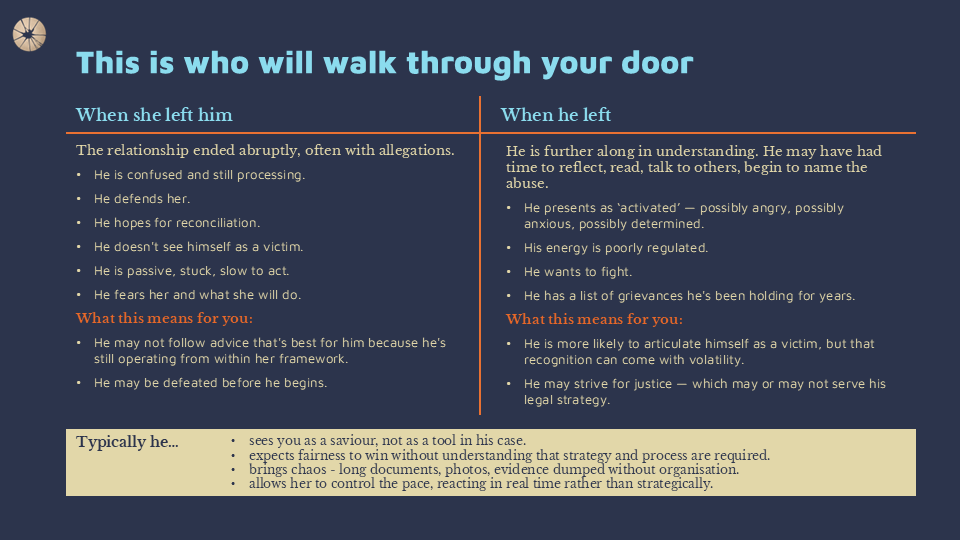
- How abusive relationships form through four formation models, which explain why the client ended up in the relationship and how they present when they walk through your door.
CPD-eligible Workshops
Stand Again also delivers CPD-eligible workshops for family law professionals, covering:
- how to recognise coercive control,
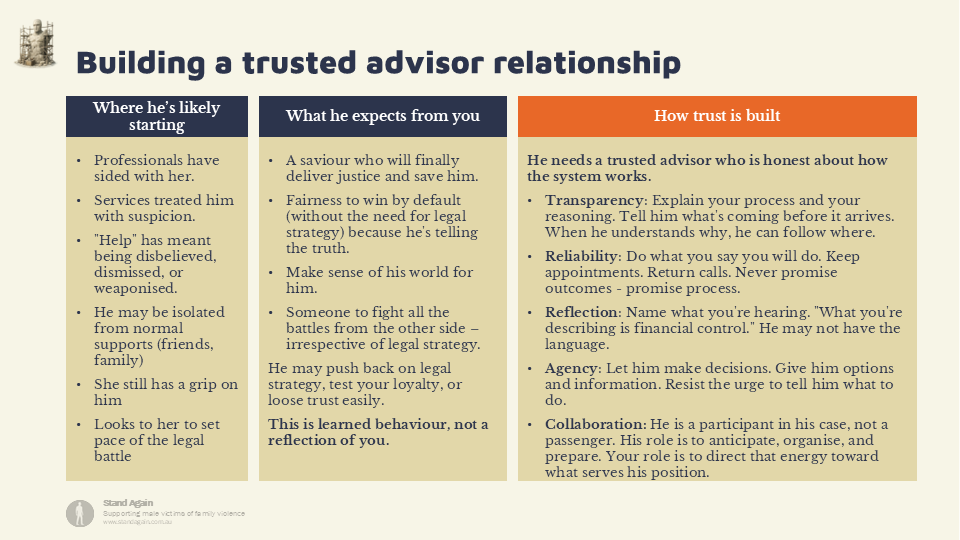
- work effectively with victims as clients, and
- apply the TTI framework in legal practice.
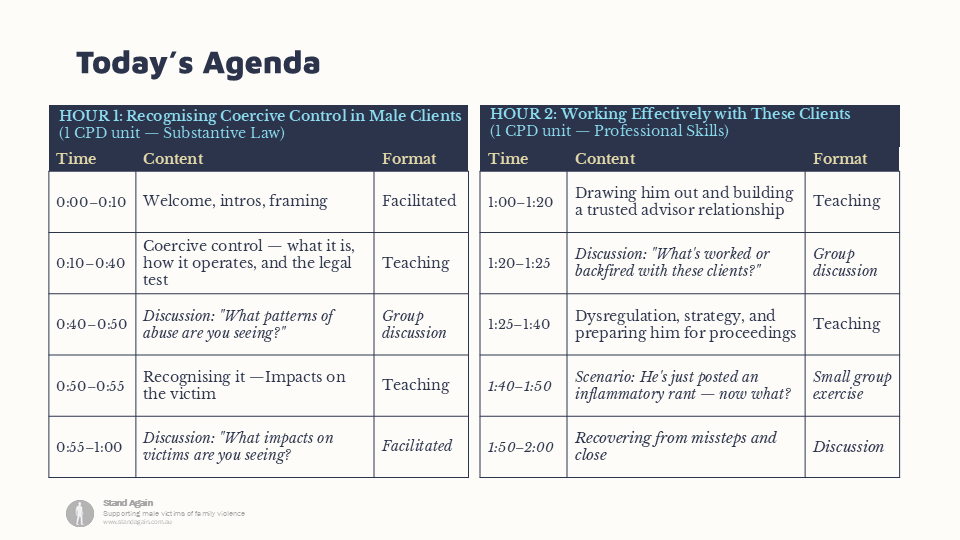
Sample slides from the Foundational Workshop